
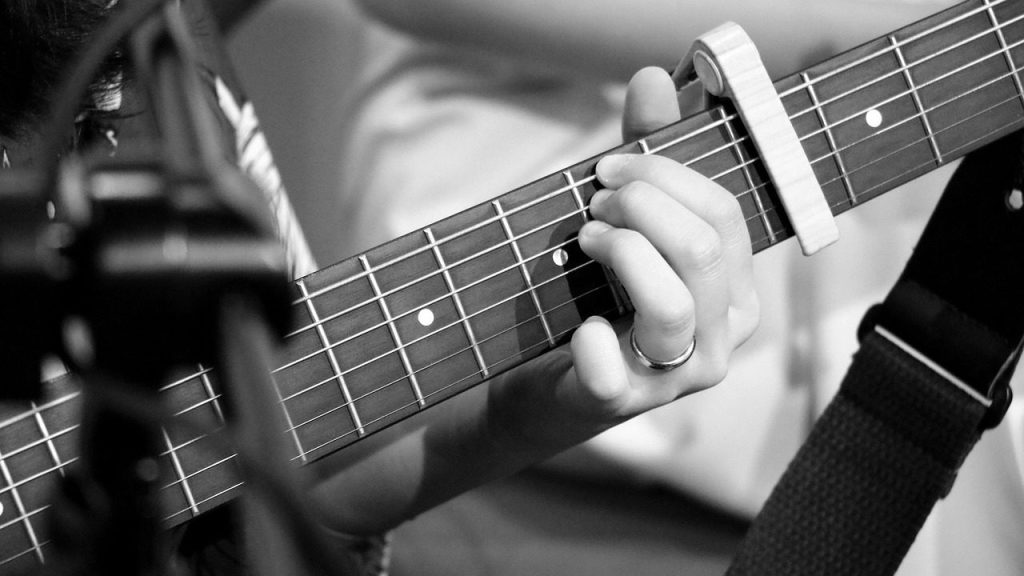
Many guitarists learn a set of open chord shapes—G, C, D, E, A—and then find songs in keys that sit awkwardly for the voice or the hands. A capo solves part of that problem by raising the pitch of the open strings, allowing you to play familiar shapes while the song sounds in a different key. This article explains the semitone arithmetic behind capo use and how to check your transpositions without leaving your chord shapes.
What a Capo Does to Pitch
A capo clamps across the fretboard and creates a new nut at a higher fret. According to the Wikipedia entry on the capo, it shortens the playable length of the strings and raises the pitch, just as if you retuned every string up by the same number of steps. The word comes from the Italian capotasto, meaning head of the fretboard, and the device has been described in sources as far back as Giovanni Battista Doni’s Annotazioni of 1640. The first patented capo was designed by James Ceòlmhor Ashborn of Wolcottville, Connecticut, in 1850. Placing a capo at the second fret raises every open string by two semitones; at the fourth fret, by four semitones. The effect applies only to the open notes—each fretted note keeps its own absolute pitch, which is why chord shapes above the capo still produce the intervals you expect.
Counting Semitones Between Chords
A semitone, also called a half-step, is the smallest interval in Western music—the distance between two adjacent keys on a piano. Twelve semitones make one octave. When you transpose a progression up by a capo, you need to know how many semitones separate the original key from the target key. For example, C to D is two semitones up, C to G is seven semitones up (or five down), and C to A is three semitones down (or nine up). Usually you only need the upward count, because a capo can only raise pitch.
Take the common open-chord progression G-C-D. If you want the same shapes to sound as A-D-E, count the distance from each chord to its target: G to A is two semitones, C to D is two semitones, and D to E is two semitones. Every chord moves by the same amount, so placing the capo at the second fret and playing G, C and D shapes gives you A, D and E. The consistency of the interval is what makes capo transposition reliable.
Reading Capo Positions in Chord Charts
Chord charts for songs that use a capo may refer to fingerings as absolute positions or as positions relative to the capo. The same D-shaped chord can be called ‘D’ based on the shape you make, or ‘E’ based on the audible chord it produces when the capo is at the second fret. Because neither convention prevails, the phrase ‘chord-shape’ is used to make clear that the fingering shape, not the audible pitch, is being described.
A useful example appears in the capo entry on Wikipedia. Two guitarists playing a I-IV-V progression in E can create a fuller sound if one plays open E, A and B7 shapes while the other places a capo at the fourth fret and plays C, F and G7 shapes. The capoed player’s C shape sounds as E, because C raised by four semitones is E; F raised by four semitones is A; and G7 raised by four semitones is B7. This shows how a single semitone count applies to every chord in the progression.
Checking Your Interval Math
You can do the arithmetic in your head, but when the target key is not obvious it helps to verify the semitone count. For simple addition and subtraction you can use an Italian-language online calculator like La Calcolatrice, which offers basic calculations, percentages and algebra without registration and runs directly in the browser. In its Standard mode you can type the number of frets and confirm, for example, that C plus four semitones equals E. The site’s interface is in Italian, but the calculator’s numeric buttons and operators remain straightforward.
The key point is that the capo fret number equals the number of semitones you want to raise the open strings. If you need to move from G to A, place the capo on the second fret. If you need to move from E to G, that is three semitones, so the capo goes on the third fret. The calculator just gives you a quick check when the interval spans more than a few frets.
Practical Capo Transposition Workflow
Start by identifying the key of the song as written in the chart. Decide the key you want to hear. Count the semitones from the original open-note key to the target key. Place the capo immediately behind the chosen fret, directly behind the metal fret, and retune the guitar after the capo is on, because adding a capo can pull strings slightly out of tune. Play the original chord shapes relative to the capo. The audible chords will now match the target key.
If the target key is lower than the original, a capo cannot help directly, because a capo only raises pitch. In that case you would need to transpose the chords downward using different shapes or use a digital transposer to shift the recording. But for moving songs into brighter, higher keys while keeping your familiar open shapes, the capo is the fastest tool on the guitar.
Conclusion
Once you can count semitones fluently, the capo becomes an extension of that arithmetic. You no longer need to look up every transposition: you just count, clamp and play. The next time a song in G feels too low, try the capo at the second fret and keep your G-C-D shapes—the song will ring in A-D-E. If you want a second opinion on the math, an Italian-language online calculator can confirm the interval in a few seconds, but the counting itself is the skill that stays with you.
Keep playing
Find your next song to learn
Browse thousands of free chord charts by instrument, difficulty, and chord count.